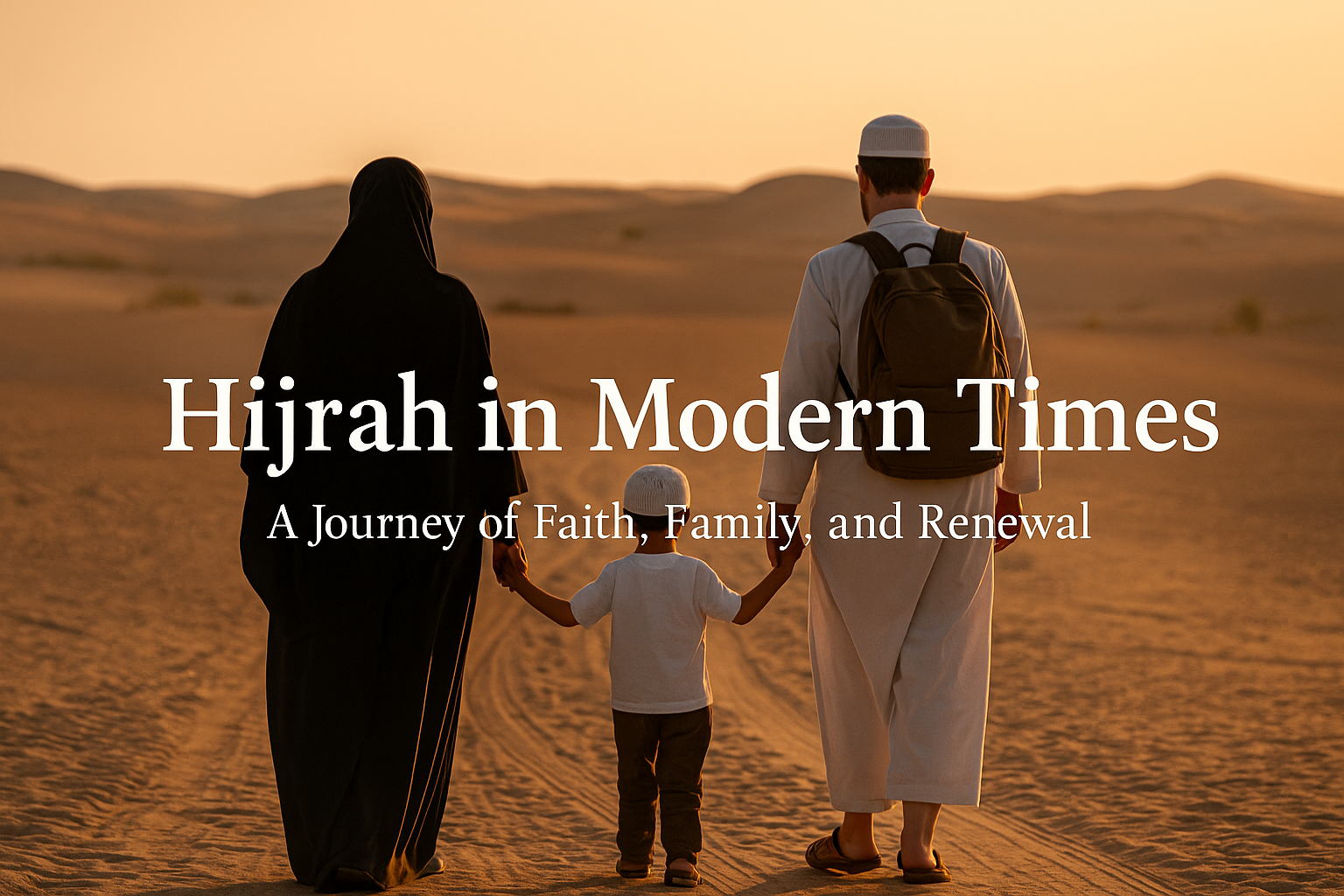
Why the call to migrate for the sake of Allah remains vital in a world that challenges faith.
Make Hijrah · Oct 08, 2025
Introduction
Among the most powerful yet neglected acts of worship in Islam is Hijrah (migration for the sake of Allah).
For many, the word calls to mind dusty caravans crossing the desert from Makkah to Madinah. Yet Hijrah is not a story frozen in history. It is a living command, a spiritual principle, and a measure of one’s loyalty to the truth over comfort.
“The true emigrant is the one who abandons what Allah has forbidden.”
— Sahih al-Bukhari (10)
The Hijrah of today may not require deserts or borders, but it still requires courage — the courage to leave behind sin, corruption, and spiritual stagnation, and to seek an environment where faith can flourish.
The Meaning of Hijrah
Linguistically, Hijrah (الهجرة) means “to leave” or “to separate from.” In the Shar‘i sense, it refers to leaving a land of disbelief or sin for a land where obedience to Allah is possible.
“Indeed, those whom the angels take [in death] while wronging themselves, the angels will say, ‘In what condition were you?’ They will reply, ‘We were oppressed in the land.’ The angels will say, ‘Was not the earth of Allah spacious enough for you to emigrate therein?’”
— Surat an-Nisāʾ (4:97)
This verse condemns those who remain in a place that prevents them from practicing their religion, even when a path of migration exists. It establishes Hijrah as not merely an act of travel, but a duty tied to the preservation of one’s religion.
Hijrah as a Continuing Obligation
Classical scholars such as Ibn al-Qayyim al-Jawziyyah and Ibn Taymiyyah emphasized that Hijrah is a continuous obligation until the Day of Judgment, so long as disbelief and disobedience exist in the world.
Ibn al-Qayyim wrote that Hijrah has two levels:
- Physical Hijrah: leaving a land where sin or disbelief dominates.
- Spiritual Hijrah: leaving all that displeases Allah toward all that pleases Him.
Both forms are intertwined. Physical migration is empty without spiritual intent, and spiritual migration is incomplete when one knowingly remains in an environment that endangers faith.
The Modern Relevance of Hijrah
In our time, Muslims in many lands (especially in the west) face subtle yet powerful forms of trial — the normalization of immorality, the erosion of modesty, and the constant temptation to compromise faith for acceptance.
For such Muslims, Hijrah may mean:
- Leaving an environment where practicing Islam freely is impossible.
- Seeking a community that supports obedience, prayer, and raising children upon Islamic values.
- Detaching from occupations or lifestyles that contradict the Shari‘ah.
“Hijrah will not cease until repentance ceases, and repentance will not cease until the sun rises from the west.”
— Sunan Abī Dāwūd (2479)
Thus, Hijrah remains open for all believers in every era. Whether through physical relocation or moral transformation, it is the path back to divine mercy.
Hijrah of the Heart
Sometimes a believer cannot physically leave his environment due to illness, financial constraints, or responsibility. In such cases, the heart can still migrate.
Ibn al-Qayyim explains that Hijrah of the heart is to detach from everything that distances one from Allah — from arrogance to humility, from heedlessness to remembrance, from desire to devotion.
“And whoever emigrates for the cause of Allah will find on the earth many [alternative] locations and abundance.”
— Surat an-Nisāʾ (4:100)
This spiritual migration is accessible to every believer. It begins the moment one decides that faith will no longer be shaped by culture, fear, or worldly comfort.
Reviving a Neglected Sunnah
For much of Muslim history, Hijrah shaped the rise of communities, the preservation of faith, and the establishment of justice. Today, as global ideologies increasingly contradict Islamic principles, Hijrah has once again become relevant — not as isolationism, but as self-preservation for the sake of Allah.
It is a call to create spaces in lands, homes, and hearts where the law of Allah is loved, learned, and lived. It reminds the believer that allegiance belongs to the truth, not to geography or comfort.
“Indeed, those who have believed and those who have emigrated and fought in the cause of Allah, it is they who hope for the mercy of Allah, and Allah is Forgiving and Merciful.”
— Surat al-Baqarah (2:218)
Conclusion
Hijrah is not a relic of the past. It is a living act of worship that separates sincerity from stagnation, truth from conformity. It reminds every Muslim that faith demands movement — sometimes of the feet, and always of the heart.
To revive Hijrah is to revive trust in Allah’s promise, to prioritize the next life over this one, and to seek an environment where Islam can be practiced fully and proudly.
Every generation has its migration. Ours may not cross deserts, but it must still cross the boundaries of fear, apathy, and worldly attachment.
Those who answer this call, as the Qur’an promises, “will find on the earth many places of refuge and abundance.”
Originally published on MakeHijrah.com. Shared here with respect to its message of faith and revival.