HasbunAllaah

Category: Articles

Global Islamic Perspective | News | Ongoing Events | General Articles

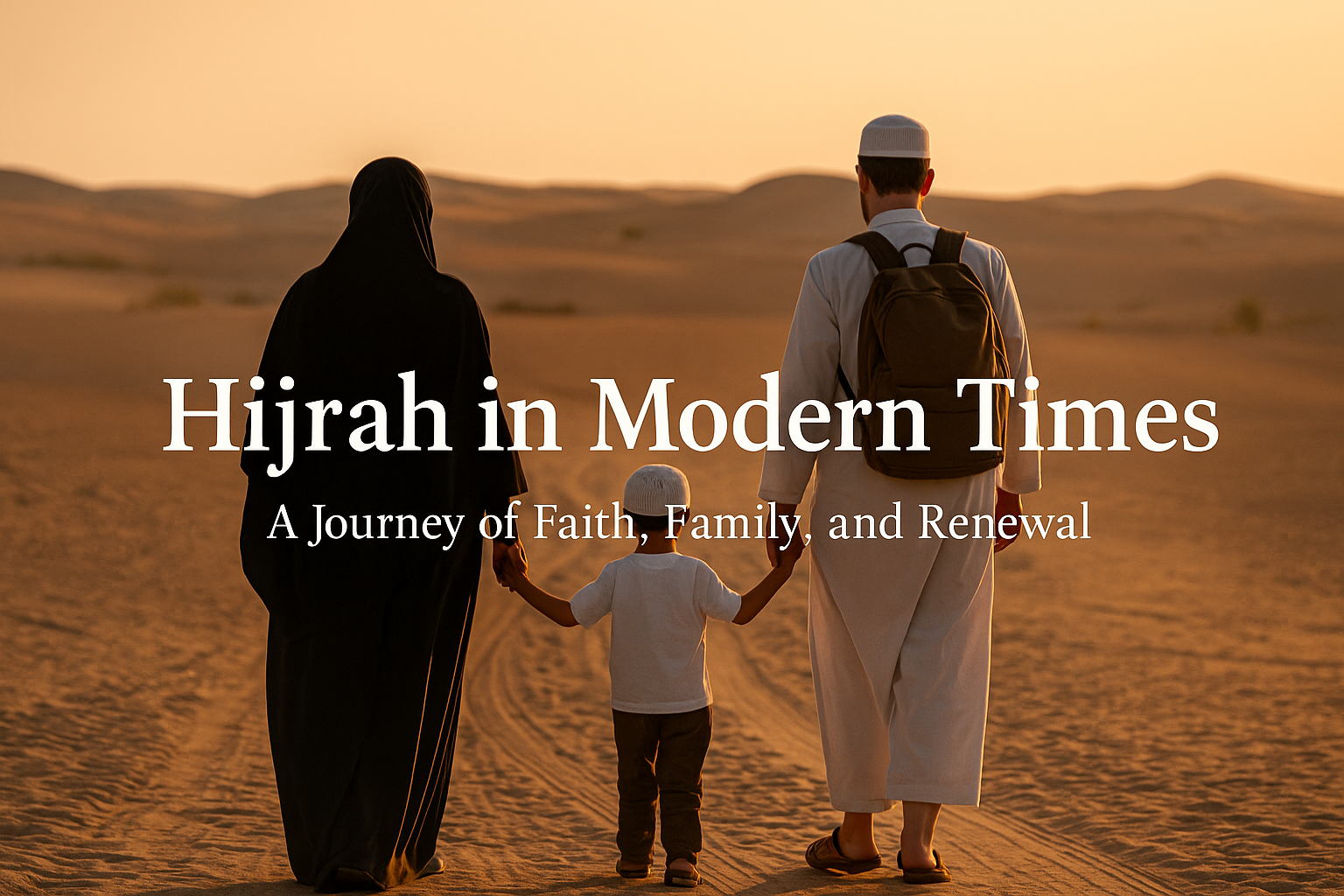
  • Hijrah: A Forgotten Act of Worship in Modern Times

    Hijrah: A Forgotten Act of Worship in Modern Times

    Why the call to migrate for the sake of Allah remains vital in a world that challenges faith.

    Make Hijrah · Oct 08, 2025


    Introduction

    Among the most powerful yet neglected acts of worship in Islam is Hijrah (migration for the sake of Allah).

    For many, the word calls to mind dusty caravans crossing the desert from Makkah to Madinah. Yet Hijrah is not a story frozen in history. It is a living command, a spiritual principle, and a measure of one’s loyalty to the truth over comfort.

    “The true emigrant is the one who abandons what Allah has forbidden.”
    — Sahih al-Bukhari (10)

    The Hijrah of today may not require deserts or borders, but it still requires courage — the courage to leave behind sin, corruption, and spiritual stagnation, and to seek an environment where faith can flourish.


    The Meaning of Hijrah

    Linguistically, Hijrah (الهجرة) means “to leave” or “to separate from.” In the Shar‘i sense, it refers to leaving a land of disbelief or sin for a land where obedience to Allah is possible.

    “Indeed, those whom the angels take [in death] while wronging themselves, the angels will say, ‘In what condition were you?’ They will reply, ‘We were oppressed in the land.’ The angels will say, ‘Was not the earth of Allah spacious enough for you to emigrate therein?’”
    — Surat an-Nisāʾ (4:97)

    This verse condemns those who remain in a place that prevents them from practicing their religion, even when a path of migration exists. It establishes Hijrah as not merely an act of travel, but a duty tied to the preservation of one’s religion.


    Hijrah as a Continuing Obligation

    Classical scholars such as Ibn al-Qayyim al-Jawziyyah and Ibn Taymiyyah emphasized that Hijrah is a continuous obligation until the Day of Judgment, so long as disbelief and disobedience exist in the world.

    Ibn al-Qayyim wrote that Hijrah has two levels:

    • Physical Hijrah: leaving a land where sin or disbelief dominates.
    • Spiritual Hijrah: leaving all that displeases Allah toward all that pleases Him.

    Both forms are intertwined. Physical migration is empty without spiritual intent, and spiritual migration is incomplete when one knowingly remains in an environment that endangers faith.


    The Modern Relevance of Hijrah

    In our time, Muslims in many lands (especially in the west) face subtle yet powerful forms of trial — the normalization of immorality, the erosion of modesty, and the constant temptation to compromise faith for acceptance.

    For such Muslims, Hijrah may mean:

    • Leaving an environment where practicing Islam freely is impossible.
    • Seeking a community that supports obedience, prayer, and raising children upon Islamic values.
    • Detaching from occupations or lifestyles that contradict the Shari‘ah.

    “Hijrah will not cease until repentance ceases, and repentance will not cease until the sun rises from the west.”
    — Sunan Abī Dāwūd (2479)

    Thus, Hijrah remains open for all believers in every era. Whether through physical relocation or moral transformation, it is the path back to divine mercy.


    Hijrah of the Heart

    Sometimes a believer cannot physically leave his environment due to illness, financial constraints, or responsibility. In such cases, the heart can still migrate.

    Ibn al-Qayyim explains that Hijrah of the heart is to detach from everything that distances one from Allah — from arrogance to humility, from heedlessness to remembrance, from desire to devotion.

    “And whoever emigrates for the cause of Allah will find on the earth many [alternative] locations and abundance.”
    — Surat an-Nisāʾ (4:100)

    This spiritual migration is accessible to every believer. It begins the moment one decides that faith will no longer be shaped by culture, fear, or worldly comfort.


    Reviving a Neglected Sunnah

    For much of Muslim history, Hijrah shaped the rise of communities, the preservation of faith, and the establishment of justice. Today, as global ideologies increasingly contradict Islamic principles, Hijrah has once again become relevant — not as isolationism, but as self-preservation for the sake of Allah.

    It is a call to create spaces in lands, homes, and hearts where the law of Allah is loved, learned, and lived. It reminds the believer that allegiance belongs to the truth, not to geography or comfort.

    “Indeed, those who have believed and those who have emigrated and fought in the cause of Allah, it is they who hope for the mercy of Allah, and Allah is Forgiving and Merciful.”
    — Surat al-Baqarah (2:218)


    Conclusion

    Hijrah is not a relic of the past. It is a living act of worship that separates sincerity from stagnation, truth from conformity. It reminds every Muslim that faith demands movement — sometimes of the feet, and always of the heart.

    To revive Hijrah is to revive trust in Allah’s promise, to prioritize the next life over this one, and to seek an environment where Islam can be practiced fully and proudly.

    Every generation has its migration. Ours may not cross deserts, but it must still cross the boundaries of fear, apathy, and worldly attachment.

    Those who answer this call, as the Qur’an promises, “will find on the earth many places of refuge and abundance.”


    Originally published on MakeHijrah.com. Shared here with respect to its message of faith and revival.

  • The Prophet Feared This More than the DAJJAL

    The Prophet Feared This More than the DAJJAL

    An urgent and powerful message calls for urgent action on global injustices, urging unity and internal reform within the Muslim world to unlock its true potential. Strong leadership and collective responsibility are key to shaping a better future.

    The speaker highlights that we see the United Nations’ failure to address the ongoing genocide in Palestine, and now, bombs were falling in Lebanon and before in Gaza. This a test for the United Nations of its existence. If the organization, which was established to prevent atrocities like those perpetrated by Nazi Germany and to stop genocides, cannot act in these circumstances, then its credibility is at risk. A clause in the UN’s rules was highlighted that permits the use of force if all peaceful means fail to stop aggression. 

    It was emphasized that something is deeply wrong when people are forced to watch innocent children being bombed without intervention. This situation underscores a larger issue within the Muslim world—despite having wealth, armies, intellectuals, and natural resources, there are deep contradictions. There is great wealth, yet poverty; large armies, yet defeat and humiliation; intellectuals debating trivial matters instead of addressing major issues. This frustration is widespread among Muslims.

    A verse from the Quran (to the meaning), states that Allah will not change the condition of a people until they change what is within themselves. Muslim world is like a giant that has been asleep for too long, groggy and unsure upon waking. Yet, change is necessary. The Prophet Muhammad (peace be upon him) warned of misguided and astray leaders, which, he said, was a more serious threat than the Antichrist (Dajjal). Leaders who lead their people astray are a grave danger, and this is something the Muslim world is facing and must confront today.

    The Ottoman Empire, at its height, succeeded by combining three key elements: a strong military, knowledgeable scholars, and a thriving economy. These three components are still essential today. However, if scholars go astray or if they are absent, the whole system crumbles. The Prophet also warned that when scholars are no longer present, ignorant leaders will take their place, leading people astray.

    In summary, this is the reality of the Muslim world today: despite having the potential for greatness, it is hindered by internal struggles, misguided leadership, and missed opportunities. The speaker urges Muslims to awaken, take responsibility, and work towards meaningful change. Leaders must be held accountable, and the Muslim world must reclaim its position through unity, knowledge, and a clear vision for the future.

    [gn_spacer]

  • Focusing on Unity: Beyond the Debate on Taraweeh Rakats

    Focusing on Unity: Beyond the Debate on Taraweeh Rakats

    In the contemporary Islamic world, debates on ritual practices often take center stage, potentially diverting attention from more pressing communal challenges. One such debate revolves around the number of Rakats (units of Islamic prayer) in Taraweeh, a special night prayer performed during the holy month of Ramadan. While some advocate for 8 Rakats, others insist on 20 or even more, citing various jurisprudential standpoints. However, in the face of global issues affecting the Muslim Ummah such as the crises in Gaza and the West Bank, Sudan, the Uyghurs’ situation, Kashmir, and India—this debate seems to overlook the broader Islamic principle of unity and mutual support. This article seeks to explore the foundations of the Taraweeh prayer in Islamic tradition, highlighting scholarly opinions and the flexibility inherent in Islamic jurisprudence, urging for a focus on unity and communal well-being.

    The Basis of Taraweeh in Islamic Tradition

    Taraweeh prayer, a hallmark of Ramadan’s nights, is deeply rooted in the Sunnah of Prophet Muhammad (peace be upon him). It is a time for reflection, spiritual growth, and community bonding. The Prophet himself led his companions in this prayer for some nights, then stopped, fearing it might become obligatory (fard) for his Ummah. This act alone signifies the flexibility and consideration in Islamic practices.

    Views on the Number of Rakats

    In the rich tapestry of Islamic practice, the Taraweeh prayer stands out as a beacon of spiritual devotion during the month of Ramadan. However, discussions about the precise number of Rakats (units of prayer) to be performed have historically been a subject of scholarly debate, reflecting the diversity within Islamic jurisprudence rather than a cause for division. If we look at what the scholars of the prominent schools of thought said, you will clearly see that this matter is broad in scope and that there is nothing wrong with doing more than eleven rak’ahs.

    References from Islamic Texts and Scholarship

    1. Hadith References:[gn_list icon=”icon: institution” icon_color=”#bf4842″]
      • Aisha’s Narration: A hadith reported by Aisha (may Allah be pleased with her) describes the Prophet Muhammad (peace be upon him) praying 11 Rakats during Ramadan, which includes Witr. This is found in Sahih Bukhari (Hadith No. 1909) and Sahih Muslim (Hadith No. 738).
      • Night Prayer General Guidance: The Prophet (peace be upon him) said, “The night prayer is offered as two Rakats followed by two Rakats and so on, and if you want to finish it, pray only one Rakat which will be Witr for all the previous Rakats.” This guidance from the Prophet emphasizes the flexibility in the number of Rakats for night prayers, including Taraweeh. This Hadith is narrated in Sahih Bukhari (Hadith No. 998).[/gn_list]
    2. Practice of the Companions:[gn_list icon=”icon: institution” icon_color=”#bf4842″]
      • Caliph Umar ibn al-Khattab’s Practice: It is narrated from several Tabi’een (successors of the Companions) that Caliph Umar ibn al-Khattab (may Allah be pleased with him) congregated the Muslims behind one Imam, Ubayy ibn Ka’b, to pray 20 Rakats of Taraweeh. This historical practice is a basis for the endorsement of 20 Rakats by some scholars and is mentioned in various historical and Hadith compilations. [/gn_list] [gn_spacer][gn_note] It should be emphasized that Umar’s actions were not an innovation but a revival of the Prophet Muhammad’s (peace be upon him) initial practice. The Prophet had led Taraweeh prayers for three days with 8 Rakats before ceasing, to prevent the congregation from assuming it was obligatory (Fard). Umar, demonstrating his wisdom, reinstated this practice after the Prophet’s passing with 20 Rakaats, thereby eliminating any concerns about it becoming a compulsory act. This decision reflects Umar’s insight in preserving the Sunnah while ensuring the community’s adherence to voluntary worship practices. This also shows Umar’s best understanding of the flexibility of the number of Rakaats in Taraweeh.[/gn_note]
    3. Scholarly Interpretations: [gn_list icon=”icon: institution” icon_color=”#bf4842″]
      • Ibn Taymiyah’s View: Ibn Taymiyah, a renowned Islamic scholar, mentioned that the number of Rakats for Taraweeh prayers is not fixed and that both the practice of praying 11 Rakats, following the Prophet’s example, and the practice of praying more, such as 20 Rakats based on the actions of the Companions, are acceptable. His discussions on this topic are detailed in his collection of Fatwas, “Majmoo’ al-Fataawa” (Volume 23, Page 113-115).
      • Imam Malik and the Maliki School: Imam Malik and the Maliki school of thought documented that the people of Medina, during the time of Caliph Umar ibn al-Khattab, prayed 20 Rakats for Taraweeh, reflecting the community practice. This is detailed in the Muwatta Imam Malik (Hadith No. 6). However, a contrasting opinion from Imam Malik suggests a practice of thirty-six Rakats, indicating a range of acceptable practices within the Islamic tradition. This is detailed in Ibn Qudamah’s work “Al-Mughni.”
      • Al-Sarkhasi, who is one of the imams of the Hanafi school, said that It is twenty rak’ahs, apart from Witr, in our view, the reference is from Al-Mabsut, 2/145)
      • Al-Nawawi declared that the Tarawih prayer, as unanimously agreed upon by scholars, is a Sunnah practice. He specifies that the customary observance involves twenty Rakats, concluded with ten salutations (Taslims), and highlights that worshippers have the option to perform this prayer either individually or in a group setting, as outlined in “Al-Majmu’.
      • Ibn Qudamah highlighted that the preferred opinion of Abu ‘Abd-Allah (Imam Ahmad) supports the view of twenty Rakats for Taraweeh prayers. This perspective is shared by other notable scholars, including Al-Thawri, Abu Hanifah, and Al-Shafi’i, who all advocate for twenty Rakats. [/gn_list]
    4. Contemporary Scholarly Opinions: [gn_list icon=”icon: institution” icon_color=”#bf4842″]
      • Scholars like Shaykh Ibn ‘Uthaymin have spoken about the importance of not allowing differences in the number of Rakats for Taraweeh prayers to cause division within the Muslim community. They emphasize that such matters, which are open to interpretation and flexibility, should not lead to disputes. Shaykh Ibn ‘Uthaymin’s views on this topic are elaborated in his work “Al-Sharh al-Mumti’” (Volume 4, Pages 73-75). [/gn_list]

    Short or long recitations of Quran in the Taraweeh:

    Whether one opts for a lengthy or brief recitation during Tarawih, it is considered appropriate to perform eleven rak’ahs in the way reported from the Prophet (peace and blessings of Allah be upon him), aligning with the Sunnah. It’s also acceptable to recite more briefly and increase the number of rak’ahs such as 20 or more. Both approaches are commendable, and neither should be criticized.

    Shaykh al-Islam Ibn Taymiyah stated:

    [gn_quote]Praying Tarawih in accordance with the jurisprudential schools of Abu Hanifah, al-Shafi’i, and Ahmad, which recommend twenty rak’ahs, or following Malik’s school, which suggests thirty-six rak’ahs, or opting for thirteen or eleven rak’ahs, is commendable. As Imam Ahmad mentioned, there’s no strict rule on the number of rak’ahs; thus, whether one prays more or fewer rak’ahs can vary based on the length of the qiyam (standing in prayer). (Al-Ikhtiyarat, p. 64) [/gn_quote]

    Al-Suyuti mentioned:

    [gn_quote]The authentic and good hadiths merely instruct observing the night prayers during Ramadan without fixing their number. There’s no conclusive evidence that the Prophet (peace and blessings of Allah be upon him) performed twenty rak’ahs of Tarawih; he prayed at night without a set number of rak’ahs. He avoided doing so on the fourth night to prevent it from becoming an obligation that might be difficult to fulfill. Ibn Hajar al-Haythami pointed out that there’s no authentic report indicating the Prophet (peace and blessings of Allah be upon him) prayed twenty rak’ahs of Tarawih. The claim that he “used to pray twenty rak’ahs” is considered very weak (da’if). (Al-Mawsu’ah al-Fiqhiyyah, 27/142-145)[/gn_quote]

    These references from Ahadith, and the works of respected scholars illustrate the rich diversity of Islamic jurisprudence and practice. The essence of the discussion points towards a broader principle of flexibility and tolerance within the bounds of Islamic law, allowing for differences based on local customs, interpretations, and ease for the worshippers.

    Conclusion

    It is crucial for scholars and the Muslim community to approach the discussion on the number of Rakats in Taraweeh prayers with a spirit of tolerance and unity. Islamic jurisprudence offers a broad and flexible framework that accommodates diverse practices and interpretations, reflecting the vast richness of the Islamic tradition. As such, it is counterproductive for scholars to insist that their specific interpretation is the only valid approach, especially when such insistence leads to division and discord among Muslims. Instead, scholars should embrace the diversity of Islamic legal thought and encourage the community to appreciate the range of valid opinions within the bounds of the Shari’ah. This approach not only aligns with the principles of Islamic Fiqh but also fosters a more cohesive and understanding Ummah. Let us remember that the strength of our community lies in our ability to unite in diversity, seeking guidance and wisdom from Allah. May Allah guide us all towards mutual respect and understanding, focusing our energies on addressing the more significant challenges facing the Ummah today.

    [gn_spacer]

  • The month of Shaban – An Analysis of Authentic and Unauthentic virtues

    The month of Shaban – An Analysis of Authentic and Unauthentic virtues

    There are many misconceptions in the Muslim Ummah regarding the month of Shaban, especially regarding its fifteenth night. In this short article, I want to enlighten the reality of this month from perspective of Qur’an and Authentic ahadeeth, so that those who want to understand the true religion will understand it. The truth should be made clear, and at the same time people who are unknowingly suffering from innovations and myths can be informed about the reality of Sha’ban by presenting evidence to them.

    In the following lines, I will try to summarize the facts of Sha’ban in ten points, through these points, almost all aspects will be highlighted briefly and it will be easy for a common reader to understand the real reality of this month.

    First point: The excellence of the month of Shaban

    Sha’ban is a month of excellence and distinction due to fasting. There are many authentic hadiths about fasting in this month, including the traditions of Bukhari and Muslim. In Bukhari Sharif, there is a tradition of Hazrat Aisha (May Allaah be pleased with her):

    Aisha, may Allaah be pleased with her, narrated that she said :

    [gn_quote]

    أن عائشةَ رضي الله عنها حدَّثَتْه قالتْ : لم يكنِ النبيُّ صلَّى اللهُ عليه وسلَّم يصومُ شهرًا أكثرَ من شَعبانَ، فإنه كان يصومُ شعبانَ كلَّه

    (صحيح البخاري:1970))

    The Prophet (may Allaah bless him and grant him peace) did not fast in any month more than Sha’ban, for he used to fast in the whole of Sha’ban.

    (Sahih Al-Bukhari: 1970). 

    [/gn_quote]

    And it is narrated in Muslim Sharif on the authority of Umm Salama, may Allaah be pleased with her:

    [gn_quote]

    سألتُ عائشةَ رضي اللهُ عنها عن صيامِ رسولِ اللهِ صلَّى اللهُ عليه وسلَّمَ فقالت : كان يصومُ حتى نقول : قد صام . ويفطر حتى نقول : قد أفطر . ولم أرَه صائمًا من شهرٍ قطُّ أكثرَ من صيامِه من شعبانَ . كان يصومُ شعبانَ كلَّه . كان يصومُ شعبانَ إلا قليلًا .

    (صحيح مسلم:1156)

    I asked Aisha (RA) about the fasts of the Prophet (PBUH), and she said: When the Prophet (PBUH) used to fast, we would say that he was fasting, and when he (PBUH) would break the fast, we would say, ‘We will not fast.’ , I did not see the Prophet ﷺ fasting more in any other month than the month of Sha’ban. He used to fast all through Sha’ban.

    (Saheeh Muslim: 1156)

    [/gn_quote]

    There is a hadith in Tirmidhi Sharif from Umm Salamah, may Allaah bless her and grant her peace:

    [gn_quote]

    ما رأيتُ النَّبيَّ صلَّى اللَّهُ عليهِ وسلَّمَ يصومُ شَهرينِ متتابعينِ إلَّا شعبانَ ورمضانَ

    (صحيح الترمذي:736)

    I did not see the Prophet, may Allaah bless him and grant him peace, fasting two consecutive months except Sha’ban and Ramadan.

    (Sahih al-Tirmidhi: 736)

    [/gn_quote]

    The same hadith is in Nasa’i with these words:

    [gn_quote]

    ما رأيتُ رسولَ اللهِ صلَّى اللهُ علَيهِ وسلَّمَ يصومُ شهرينِ متتابعينِ ، إلَّا أنَّه كان يصِلُ شعبانَ برمضانَ

    (صحيح النسائي:2174)

    I did not see the Messenger of Allaah, may Allaah’s blessings and peace be upon him, fast the two consecutive months, except that he used to combine Sha’ban with Ramadan

    (Sahih al-Nasa’i: 2174)

    [/gn_quote]

    From all these ahadiths, there is an evidence of fasting only, i.e. fasting most of Sha’ban, and the traditions that mention fasting the whole of Sha’ban also mean fasting most of Sha’ban.

    On the wisdom of fasting abundantly in this month, it was narrated from Usama bin Zayd, may Allah be pleased with him:

    [gn_quote]

    يا رسولَ اللَّهِ ! لم ارك تَصومُ شَهْرًا منَ الشُّهورِ ما تصومُ من شعبانَ ؟ ! قالَ : ذلِكَ شَهْرٌ يَغفُلُ النَّاسُ عنهُ بينَ رجبٍ ورمضانَ ، وَهوَ شَهْرٌ تُرفَعُ فيهِ الأعمالُ إلى ربِّ العالمينَ ، فأحبُّ أن يُرفَعَ عمَلي وأَنا صائمٌ

    (صحيح النسائي:2356)

    I asked the Messenger of Allah, may Allaah bless him and grant him peace, that you do not fast as much in any other month as you do in Sha’ban? The Prophet (PBUH) replied: This is a month in which people become negligent, which is between Rajab and Ramadan. This is the month where (our) deeds are elevated (and presented) to our Lord of the Worlds (Allaah), and I like that my deeds are elevated (to Allaah) whilst I am fasting.

    (Sahih al-Nasa’i: 2356)

    [/gn_quote]

    In summary, following the example of the Prophet ﷺ, we should fast (only) in the month of Shaban, and that is in abundance, and we should not perform any actions for which there is no evidence.

    Second point: Fasting after half of Sha’ban

    From the above hadiths, it is known that it is permissible to fast most of Sha’ban, but there are also some traditions in which fasting after half of Sha’ban is prohibited.

    Hazrat Abu Huraira (may Allah be pleased with him) says that the Messenger of Allah (ﷺ) said:

    [gn_quote]

    إذا بقيَ نِصفٌ من شعبانَ فلا تصوموا(صحيح الترمذي:738)

    If half of Sha’ban remains, then do not fast.

    (Sahih al-Tirmidhi: 738)

    [/gn_quote]

    There are many narrations of this meaning which have been narrated by Abu Dawood, Nasa’i, Bayhaqi, Ahmad, Ibn Abi Shaiba and Ibn Hibban etc. with the difference of words. There is a difference of opinion among scholars regarding the authenticity of this hadith. Imam Tirmidhi, Imam Ibn Habban, Imam Tahawi, Abu Awana, Imam Ibn Abdul Bar, Imam Ibn Hazm, Allama Ahmad Shakir, Allama Albani, Allama Ibn Baz and Allama Shoaib Arnaut etc. Ibn Mahdi, Imam Ahmad, Abu Zareah Razi, Imam Ashram, Ibn Al-Jawzi, Bayhaqi, Ibn Moin and Sheikh Ibn Uthaymeen etc.
    Ibn Rajab said that there is a difference of opinion regarding the validity of this hadith. Those who corrected it are Tirmidhi, Ibn Hibban, Hakim, Tahawi and Ibn Abdul Burah, and those who spoke on this hadith are more senior and knowledgeable than these people. These people have denied the hadith, they are Abd al-Rahman bin Mahdi, Imam Ahmad, Abu Zareah Razi, Athiram (Lataif al-Maarif p. 135).

    For this reason, this hadith is negative and unproven. Exceptions are the following people:

    [gn_list icon=”icon: institution” icon_color=”#bf4842″]

    • He who is in the habit of fasting, for example a person who is used to fasting on Mondays and Thursdays, then he will fast even after half of Shaban.
    • He who started fasting before half of Sha’ban and mixed the first half of Sha’ban with the latter.
    • The person who fasts during Ramadan will also be exempted from this.
    • In following the Prophet ﷺ, one can fast Sha’ban as often as he wants, so long as he does not become weak for the fast of Ramadan.

    [/gn_list]

    The third point: Fasting half of Sha’ban

    There is not a valid hadith which provides an argument for fasting on the 15th of Sha’ban. Sahih hadiths provide an argument for fasting most of Sha’ban as mentioned above. Those who fix the 15th of Sha’ban for fasting commit innovation in religion and innovation leads to hell. If someone says that there is a hadith related to fasting on the fifteenth of Sha’ban, then I will say that such a tradition has been created and fabricated. Whoever ascribes the ascribed tradition to the Prophet ﷺ will have his abode in Hell (as per the hadeeth of Prophet (PBUH)).

    The fourth point: Staying the night of half of Sha’ban

    Different types of special worship are performed on the night of half of Sha’ban based on false and false traditions. It is narrated by Ibn Majah:

    [gn_quote]

    إذا كانت ليلةُ النِّصفِ من شعبانَ فقوموا ليلَها ، وصوموا نَهارَها

    (ضعيف ابن ماجه:261)

    When the night of the half of Sha’ban comes, then perform Qayam (Night prayers) and fast during the day.

    (Da’if Ibn Majah: 261).

    [/gn_quote]

    This tradition has been created because there was a narrator in it, Abu Bakrban Muhammad, who fabricated the traditions. On this night, Salat al-Fiyah, that is, a special way of praying with one thousand rakats, some people pray 100 rakats, some people fourteen rakats and some even twelve rakats. There is no specific worship of this type reported from the Prophet ﷺ and his Companions. Similarly, there is no evidence of collective dhikr, collective prayer, collective Quran reading and collective action on this night.

    The fifth point: The concept of Shab Barat

    It is called the night of the fifteenth of Sha’ban by different names. For example, Lailat al-Mubarakah (the night of blessings), Lailat al-Saq (the night of division of affairs), Lailat al-Rahma (the night of the descent of mercy). There is also a name Shab-e-Barat (night of deliverance from Hell) which is very common. In fact, these names have no legal status.

    Lailat al-Mubaraka is not performed on the night of half of Sha’ban, but on the night of Qadr, Allah says:

    [gn_quote]

    إِنَّ أَنزْلْنَاحُ فَيْلَةٍ مُُّبَارَكَةٍ إِنَّ كَنَّة المنزِرِينَ

    Verily, We have sent down this (Qur’an) in a blessed night, for We are a warner.

    {Al-Dukhan: 3}

    [/gn_quote]

    Allah Ta’ala revealed the Qur’an in Lailat al-Mubaraka, i.e. Lailat al-Qadr, as Allah says in another place:

    [gn_quote]

    إِنَّا أَنزَلْنَاهُ فِي لَيْلَةِ الْقَدْرِ

    [القدر:1]

    We sent it (the Qur’an) down in the Night of Decree.

    [/gn_quote]

    The division of affairs is only done on the night of Qadr and not on the night of half of Sha’ban, and there is no reason to call it “Lailalu-ur-Rahmah”. As far as Shab-e-Barat is concerned, that too is not proven, the argument given for it is weak. This hadith will be explained later.

    Sixth point: Visiting the graveyard on the night of half of Sha’ban

    In Tirmidhi, there is a hadith on the authority of Aisha, may Allaah be pleased with her:

    [gn_quote]

    فقَدتُ رسولَ اللَّهِ صلَّى اللَّهُ عليهِ وسلَّمَ ليلةً فخرجتُ فإذا هوَ في البقيعِ۔

    One night I found the Holy Prophet (peace and blessings of Allah be upon him) missing from my side .

    [/gn_quote]

    This tradition is related to the half of Sha’ban, based on this hadith, the cemetery is cleaned on the night of the fifteenth of Sha’ban, the graves are cleaned, electricity and lamps are installed there, and men and women visit the cemetery together on this night, while the above hadith is graded weak and hence, it will not be implemented. Visiting graves is always Masnoon (Sunnah), so it is an innovation to set a date for it, and it is never permissible to visit graves with a mixture of men and women, and to set up fairs on graves.

    Seventh Point: Fireworks

    As much money is spent on performing innovation and superstitions in Sha’ban, if charity were given in this way in Ramadan, many poor people would be relieved and reserves for the Hereafter would also be provided. However, the one who loves to spend extravagantly (Israaf) which is a devilish act,  there is no hope in him to spend in charity. As soon as the month of Sha’ban begins, firecrackers start to be released. Just imagine how much waste there will be during the whole of Sha’ban from that time onwards. And it is observed there is no limit to this deed on the night of half-Sha’ban which leads to both bodily harm and financial waste. 

    Eighth Point: Arrival of certain dishes and spirits

    One of the innovations of half of Sha’ban is to prepare different kinds of food, Halwa Puri (Sweet dish) and different kinds of dinner, they distribute it among the poor and the needy and they believe that spirits come, for this reason, Al-Fatiha is recited for them. They also believe that if Halwa Puri is not made today, spirits will lick the walls. How much of this deed is similar in concept to the western festival of Halloween, Subhan Allaaah.

    Fixing a date for cooking food and distributing it to the poor on the specified date, reciting the Fatiha on this food, giving reward to the men for the Fatiha are all bad deeds. And know that the soul does not return to the world after death, there are many verses in the Qur’an as Allah says:

    [gn_quote]

    کَلاَّ إِنَّها کَلِمَةٌ هُوَ قائِلُها وَ مِنْ وَرائِهِمْ بَرْزَخٌ إِلي‏ يَوْمِ يُبْعَثُونَ(المومنون: 100)

    Never! It is only a useless appeal they make. And there is a barrier behind them until the Day they are resurrected.

    {Al-Muminoon: 100}

    [/gn_quote]

    Ninth point: On the half of Sha’ban, Allah descends from the sky to the world.

    A tradition is presented with great vehemence:

    [gn_quote]

    ان الله ليطلع في ليلة النصف من شعبان فيغفر لجميع خلقه إلا لمشرك أو مشاحن

    (سنن ابن ماجه :1390 ) 

    Allah looks down (on His servants) in the half of Sha’ban night, then He forgives all creation except the polytheist and the one who has enmity (to the Muslim brother).

    [Sunan Ibn Maja: 1390]

    [/gn_quote]

    This hadith has been graded as Hasan by al-Albani, while it has a famous weak narrator, Ibn Lahiyyah, and it is also weak in all other ways. This tradition has also come through Aisha (May Allaah be pleased with her):

    [gn_quote]

    إنَّ اللَّهَ تعالى ينزِلُ ليلةَ النِّصفِ من شعبانَ إلى السَّماءِ الدُّنيا ، فيغفرُ لأكْثرَ من عددِ شَعرِ غنَمِ كلبٍ

    (ضعيف ابن ماجه:262)

    Allaah, the Almighty, descends on the night of the middle of Sha’ban to the lowest heaven, and forgives (people) more than the number of hairs from the sheep of Banu Kalb (Tribe).

    (Da’if Ibn Majah: 262).

    [/gn_quote]

    Sheikh Al-Albani has graded this hadeeth as weak; Imam Bukhari (may Allah have mercy on him) has also mentioned a break in the chain of transmission due to which it is weak.

    Anyway! There is no specific proof of Allah’s descent on the lowest heaven on the night of half of Sha’ban ONLY, but it is included in the generality of another hadith in which it is mentioned that Allah Almighty descends on the sky in the third part of every night. Hence, explicit mentioning of Allah’s descent on this night ONLY does not make any sense.

    Tenth point: The order of hadiths related to the fifteenth of Sha’ban

    In the last point, let me make it clear that there is no authentic hadith related to the day of half of Sha’ban or its night. The hadith of deciding life and death, the hadith of the forgiveness of previous sins sixty years after fasting on this day, the hadith of reading twelve-fourteen-hundred and one thousand rakats of Nafil, and any of the hadiths related to fasting and fasting on Shaban and the rewards are not valid. 

    For this reason, it is not permissible to perform any specific action on the day of the fifteenth of Sha’ban or perform any specific worship on the night of the fifteenth of Sha’ban. In the month of Sha’ban, there is evidence that the Prophet ﷺ fasted abundantly, so Muslims should limit themselves to this act and not waste the good deeds they have already accumulated by committing innovations and superstitions.

    ~ Written by Ustaadh Maqbool Ahmed

    [Translated from Urdu, edited and compiled by HasbunAllaah]

    [gn_divider]
     

  • The principle of Certainty (Yaqeen)- by Sheikh Abu Adnan

    The principle of Certainty (Yaqeen)- by Sheikh Abu Adnan

    [gn_spacer=”10″]

    Indeed it is a failure to our Reason to define ”Faith” as the belief in the truth of something that does not require any evidence.

    [gn_note note_color=”#fcf5e5″]

    Faith without Certainty “يقين”, essentially opens the possibility of believing in a myth. Conceptualising something in our minds does not necessarily mean it exists outside of our minds (in the realm of reality).

    [/gn_note]

    For instance, when we were kids, some of us had an imaginary friend. It’s that person who lived inside our minds, we talked, played and sometimes we got angry with it.

    Hence, I can believe in the existence of an imaginary friend and act as if it exists in reality. Such belief would fall under this definition of ”Faith”, as I do not require evidence to prove its existence. If I fail to rationalise its existence, then, I can explain its existence by way of faith.

    Rather, it is by way of Reason; we can prove or deny the existence of something. In the bush, if you see a narrow trodden path, you deduce with certainty that someone or something before you walked such a path. This is what we usually call common sense; “common” because it is standard with every human brain.

    Therefore, the term “Faith” in its true definition is nothing but a nice garment to dress up the failure of rationalising certain Dogmas or actions due to their inherent irrationality. This means he/she believes in the existence of what could be a myth, and such a possibility does not maintain Certainty.

    In the Quran, the word Imaan does not mean “Faith” as above defined. Instead, all mainstream Islamic Schools of Theology emphasise on the principle of Certainty “يقين” and its role as a pivotal element of Imaan.

    The same can be said on using the word “………..” in explaining some of the sequences of events that lead to our existence.

    However, if you want the Best of Words, scrap the above and reflect on the following from Suratul Ikhlaas:

    [insert_quran surah=”112″ ayah=”1″]

    Implies:

    Affirmation of His absolute Monotheism, and by necessity a denial of Dualism.

    [insert_quran surah=”112″ ayah=”2″ end=”3″]

    Implies from both the above verses:

    Severs the chain of infinite regress.

    [insert_quran surah=”112″ ayah=”4″]

    A total denial of the existence of any equals.

    To be continued…….

    ~ Written by Sheikh Abu Adnan

    [gn_divider]

  • How Can You Help the Oppressed ?

    How Can You Help the Oppressed ?

    This article discusses what we can do as an individual for our brothers and sisters who are suffering specially in Ghouta (Syria), besides the oppressed ones in Palestine, Myanmar, Kashmir and else where.

    [gn_note note_color=”#bf4842″ text_color=”#f4f4f4″]

    We often hear this:

    We’re here far away, what we can do?

    There is nothing we can do except Dua?

    [/gn_note]

    There are 6 actions points (at least) which one can do as a Muslim:

    1. Firm Belief in Allah

    A Muslim puts his complete trust in Allaah in every affair with full Ikhlaas (sincerity). If we look at every other matter in this world, it is measured in terms of outcome which is in contrast with our dealing with our Rab, our creator. Where His obedient Servant puts his effort to the best of his ability, exhaust all his resources and then leave the results upon Allah to be decided irrespective of the outcome with full acceptance to the Qadar of Allaah. In summary, Allah Subhana Wa Ta’ala judges you with how much effort you’ve put in and not by how much you achieved out of those efforts.

    In Quran’s almost every chapter, there is a purpose of why Allaah Subhana Wa tala has mentioned the story of Prophet Musa Alehis Salam and Fir’awn. Was it just a Story or a Sign for us? Let us recall that story for a while:

    Allah says in the Glorious Qur’an:

    [gn_quote]

    We recite to you some of the news of Moses and Pharaoh in truth, for a people who believe.  Verily, Pharaoh exalted himself in the land and made its people sects, weakening (oppressing) a group (i.e. Children of Israel) among them; killing their sons, and letting their females live.  Verily, he was of those who commit great sins and crimes, oppressors, tyrant.

    (Quran 28:3-4)

    [/gn_quote]

    And then the scene changes completely which no one had ever thought about it, as Allah says:

    [gn_quote]

    And We wished to do a favor to those who were weak (and oppressed) in the land, and to make them rulers and to make them the inheritors, And to establish them in the land, and We let Pharaoh (Fir’awn)and Haman (Egypt’s Chief Minister)  and their hosts receive from them that which they feared.

    (Quran 28:5&6)

    [/gn_quote]

    What was the reason behind Musa triumph over Fir’awn after the weakest of the Bani Isra’il was prosecuted continuously? Was it accidental? No not all.

    We know the story when the Banu Isra’il saw defeat in front of them along with Musa Alehis Salam when the army of Fir’awn chased them up. They were in absolute fear, however Allaah granted them victory by drowning the Fir’awn and his strong army in the River Nile consequently. But before that, something happened. Musa Alehis Salam replied to his nation that My Rab will not leave me alone. Allah ordered Musa Alehissalam to strike his stick in the water. Well, feasibility of this action suggests that it was not going to work. Can a stick make a difference? However he was Prophet Musa Alehis Salam who did not think for a second that i was at the verge of being slaughtered by the Fir’awn’s army along with my people and Allaah Subhana Wa ta’la had asked me to strike my stick in the river. He did not ponder for a second to find out the relationship between striking the stick and getting assisted by Allah. This was mere Tawakkal of Prophet Musa Alehis Salam upon his Rab, his protector. Musa Alehis Salam did the effort what he was commanded to do so and the the same action was magnified and amplified to the extent that led to the drowning of the biggest oppressor of that time.

    Behind every man’s success is a woman and we see this in the case of Musa Alehis Salam as well. We know from the story of Musa Alehis Salam that Fir’awn became so fanatical in his oppression that he used to send spies or security agents to seek out pregnant women.  If any woman gives birth to a male child, he is immediately put to death. What led the mother of Musa Alehis Salam to obey the inspiration from Allaah to her that she put her dearest child whom she had been preventing from Fir’awn and his army from getting killed, to put in the river? As the story unfolds we then read that:

    [gn_list icon=”icon: institution” icon_color=”#bf4842″]

    • He (Subhana Wa Tala) made Musa Alehissalam the prince in the house of Fir’awn
    • He was raised, nourished and dressed like a prince in the house of Fir’awn
    • His mother who put her in river Nile of fear of the army of Fir’awn, was now invited to the castle of Fir’awn to breastfeed her own son with full protocol.

    [/gn_list]

    Let us take a break here for a moment ! At the time she put Musa Alehissalam in the river, did she know this was going to happen? Off course NOT, and this is the same Tawakkal, the reliance upon Allah that led her to do so. In return Allaah not only secured her and Musa Alehis Salam but guaranteed them security till a time when Allaah Subhana Wa’tala made Musa a Prophet and until the time when Fir’awn’s army was defeated and drowned.

    Let’s make a firm belief in our hearts that Allah has the power over everything. Nothing can escape from Him. He has the dominion over every throne. Allah will give victory to this Ummah, our role is to believe fully in Allah’s promise and do our part by relying on him Alone, and obeying Allah and His noble Messenger (Sallallahu Alehe Wasallam).

    2. Dua (Supplication)

    Rasool Allah (Sallallahu Alehe Wassalam) said:

    [gn_quote]

    Dua is the weapon of the believer.

    [/gn_quote]

    Firstly we should ask this question to ourselves: How many times in a day we make Dua for our oppressed brothers and sisters in Islam? Do we remember them in our daily discussions with our peers, our relatives, friends and families? Someone whom we claim to love and attach to, should automatically come out of our tongue. If this not happening, then our claim is wrong.

    Secondly, do not belittle or stop making Dua. Many times we exhaust in making dua and then stop doing it just because we’re not getting the desired outcome. Well this could be of multiple reasons. Firstly, there is a time set by Allaah, the best of the planners, for this to be accepted. Moreover, Allaah wants to provide this opportunity to his servants of making Dua for the fellow Muslims, which is an Ibadah hence piling up the Hasanat. Furthermore, our Dua is like the pebbles which are thrown one after another until it breaks the shield completely. Do not Stop the Dua as you do not know the matters of unseen.

    Thirdly, for a weapon to be effective and impact-ful, the one using it should be skillful and should know how to use it effectively. If sincerity, Khushoo’ are missing from the Dua without even knowing what is being recited in the dua (due to language) then how can one expect his/her Dua to be effective and being accepted? The one making the Dua is to be blamed and not the Dua’ itself.

    3. Dua Al-Qunoot

    This a a neglected Sunnah, and we have set it aside only for the month of Ramadan. It is proven from authentic narrations from Prophet Sallallahu Alehe wassallam that in times of calamity, he used to read Al-Qunoot in the last Raka’ of Fajr, in Fard Salah and in voluntarily Salaawat (prayers). Let’s make it a habit of praying it at least in one Salah per day and ask Allaah, the most merciful to remove the sufferings from the Muslim Ummah and from mankind, wherever the oppression persists.

    4. Leaving the sins you’re upon and turn back to Allaah

    Sins are the destruction for the Ummah. How many nations before us were destroyed because of their sins. Today, all the sins committed by previous nations are rampant and progressed deeply in us in one package. In this situation, the wrath of Allaah Subhana Wa Ta’ala and not deserving to receive his help and Nusrah is inevitable. An individual is a unit of a society which makes a nation. One should now act and make an intention to leave the major or minor sins he/she is upon and turn back to his Lord, the most merciful and compassionate.

    5. Sadaqah (Charity)

    Scholars have made commentaries on the aspect of sins committed by an individual and communities. Sins brings disasters to the Ummah. One way of reducing sins is to do more and more good deeds and one of the best ways of doing it is Giving Sadaqah. If it is intended for those in severe need of you after Allaah, then what good is better than it. Don’t reserve your big donations for Ramadan only, let’s open our hearts and donate in the path of Allaah to whichever organisation you trust, who are on or off the ground assisting refugees and those impacted.

    6. Create Awareness among people

    Alas! this is the saddest part.

    As our Prophet Sallallahu Alehe wassalam said (to the meaning of the hadeeth) that one is not a true believer who is not concerned with the affairs of the other Muslim.

    How can a Muslim sleep after seeing his brothers and sisters oppressed and at least not making Dua for them?

    How many countries made a news headline to this oppression being done in Myanmar? Or if any did, was it given due coverage?

    As our Prophet Sallallahu Alehe wassalam said (to the meaning) that all the Muslims are like one body so if one component of the body is in pain, the other part also feels the pain. Media makes the mind of the people. It is our duty to generate awareness among the people – Muslims and non-Muslims alike through social media, and whichever ways you’ adopt to.

    In the end,

    I ask Allaah Subhana Wa Tala to grant our Ummah firm faith to have full tawakkal upon Allaah, His plans and decisions, to have complete belief in the Qadar of Allah as whatever happens has a goodness in it though we haste to dislike it.

    May Allaah give us Tawfiq to make Dua, give Sadaqah for His cause and feel pain for the Muslim Ummaah as it deserves. A Muslim is not only concerned about himself and his family only, or his relationship between him and Allaah only (Huqooq Allaah) but he is also concerned for the community and society as well (Huqooq Al-Ibaad). May Allaah grant victory to this Ummah like He gave to Bani Israil after decades of oppression. Verily Allaah does not go against His promise.

    [gn_divider]

  • When they Challenged Allah (Al-Jabbar)

    When they Challenged Allah (Al-Jabbar)

    It is only if the mankind comes to know who their Lord is, and what is the understanding and reflection of the names and attributes of their Lord is, only when the tyranny and arrogance will go away. One of the 99 names of Allah is Al-Jabbar (The Mighty, the All powerful) which when associates with His (SWT) creation becomes a blameworthy attribute.

    A beautiful reminder explaining this attribute while taking the short lessons from the history of some of the biggest tyrants who ever walked on this face of earth, who when became Jabbar and challenged Allah, faced the anger and wrath of Allah, Subhana Wa ta’ala.

    [gn_spacer size=”10″]

    [gn_youtube_advanced url=”https://www.youtube.com/watch?v=1ia9TdLIQB0″ controls=”no” rel=”no” modestbranding=”yes”]

    [gn_divider]

  • Do Not belittle Your share | Spread the word

    Do Not belittle Your share | Spread the word

    And it happens again.

    Aleppo has been burning till the time of writing this article. The buildings are being bombarded with bombs, hospitals are crushed into sands, our Muslim Civilians sisters getting raped, and men and children are being slaughtered. However like others i am not going to paste here those graphic images or videos to put salt into the wounds of this Ummah. Yes, i am not going to rebuke or refute the criminal silence of 57 Islamic countries upon these atrocities. I am not going to rebuke that country who claims it to be the castle of Islamic Ummah. I am not going to rebuke our leaders of those 57 countries who only care about the issues which concern keeping their thrones persistent. I am not going to discuss these as there is no benefit of doing so, as you’re well aware of them more than me.

    Let me go straight to the topic which i would like to highlight.

    [gn_note note_color=”#bf4842″ text_color=”#f4f4f4″]

    We often hear this:

    We’re here far away, what we can do?

    There is nothing we can do except Dua?

    [/gn_note]

    In this article, we will discuss very quickly what we can do as a Fard Wahid (an individual) for our brothers and sisters who are suffering in Aleppo, Myanmar, Palestine, Kashmir and else where.

    There are 5 actions points which one can do as a Muslim right now:

    1. Firm Belief in Allah

    A Muslim puts his complete trust in Allaah in every affair with full Ikhlaas (sincerity). If we look at every other matter in this world, it is measured in terms of outcome which is in contrast with our dealing with our Rab, our creator. Where His obedient Servant puts his effort to the best of his ability, exhaust all his resources and then leave the results upon Allah to be decided irrespective of the outcome with full acceptance to the Qadar of Allaah. In summary, Allah Subhana Wa Ta’ala judges you with how much effort you’ve put in and not by how much you achieved out of those efforts.

    In Quran’s almost every chapter, there is a purpose of why Allaah Subhana Wa tala has mentioned the story of Prophet Musa Alehis Salam and Fir’awn. Was it just a Story or a Sign for us? Let us recall that story for a while:

    Allah says in the Glorious Qur’an:

    [gn_quote]

    We recite to you some of the news of Moses and Pharaoh in truth, for a people who believe.  Verily, Pharaoh exalted himself in the land and made its people sects, weakening (oppressing) a group (i.e. Children of Israel) among them; killing their sons, and letting their females live.  Verily, he was of those who commit great sins and crimes, oppressors, tyrant.

    (Quran 28:3-4)

    [/gn_quote]

    And then the scene changes completely which no one had ever thought about it, as Allah says:

    [gn_quote]

    And We wished to do a favor to those who were weak (and oppressed) in the land, and to make them rulers and to make them the inheritors, And to establish them in the land, and We let Pharaoh (Fir’awn)and Haman (Egypt’s Chief Minister)  and their hosts receive from them that which they feared.

    (Quran 28:5&6)

    [/gn_quote]

    What was the reason behind Musa triumph over Fir’awn after the weakest of the Bani Isra’il was prosecuted continuously? Was it accidental? No not all.

    We know the story when the Banu Isra’il saw defeat in front of them along with Musa Alehis Salam when the army of Fir’awn chased them up. They were in absolute fear, however Allaah granted them victory by drowning the Fir’awn and his strong army in the River Nile consequently. But before that, something happened. Musa Alehis Salam replied to his nation that My Rab will not leave me alone. Allah ordered Musa Alehissalam to strike his stick in the water. Well, feasibility of this action suggests that it was not going to work. Can a stick make a difference? However he was Prophet Musa Alehis Salam who did not think for a second that i was at the verge of being slaughtered by the Fir’awn’s army along with my people and Allaah Subhana Wa ta’la had asked me to strike my stick in the river. He did not ponder for a second to find out the relationship between striking the stick and getting assisted by Allah. This was mere Tawakkal of Prophet Musa Alehis Salam upon his Rab, his protector. Musa Alehis Salam did the effort what he was commanded to do so and the the same action was magnified and amplified to the extent that led to the drowning of the biggest oppressor of that time.

    Behind every man’s success is a woman and we see this in the case of Musa Alehis Salam as well. We know from the story of Musa Alehis Salam that Fir’awn became so fanatical in his oppression that he used to send spies or security agents to seek out pregnant women.  If any woman gives birth to a male child, he is immediately put to death. What led the mother of Musa Alehis Salam to obey the inspiration from Allaah to her that she put her dearest child whom she had been preventing from Fir’awn and his army from getting killed, to put in the river? As the story unfolds we then read that:

    [gn_list icon=”icon: institution” icon_color=”#bf4842″]

    • He (Subhana Wa Tala) made Musa Alehissalam the prince in the house of Fir’awn
    • He was raised, nourished and dressed like a prince in the house of Fir’awn
    • His mother who put her in river Nile of fear of the army of Fir’awn, was now invited to the castle of Fir’awn to breastfeed her own son with full protocol.

    [/gn_list]

    Let us take a break here for a moment ! At the time she put Musa Alehissalam in the river, did she know this was going to happen? Off course NOT, and this is the same Tawakkal, the reliance upon Allah that led her to do so. In return Allaah not only secured her and Musa Alehis Salam but guaranteed them security till a time when Allaah Subhana Wa’tala made Musa a Prophet and until the time when Fir’awn’s army was defeated and drowned.

    Let’s make a firm belief in our hearts that Allah has the power over everything. Nothing can escape from Him. He has the dominion over every throne. Allah will give victory to this Ummah, our role is to believe fully in Allah’s promise and do our part by relying on him Alone, and obeying Allah and His noble Messenger (Sallallahu Alehe Wasallam).

    2. Dua (Supplication)

    Rasool Allah (Sallallahu Alehe Wassalam) said:

    [gn_quote]

    Dua is the weapon of the believer.

    [/gn_quote]

    Firstly we should ask this question to ourselves: How many times in a day we make Dua for our oppressed brothers and sisters in Islam? Do we remember them in our daily discussions with our peers, our relatives, friends and families? Someone whom we claim to love and attach to, should automatically come out of our tongue. If this not happening, then our claim is wrong.

    Secondly, do not belittle or stop making Dua. Many times we exhaust in making dua and then stop doing it just because we’re not getting the desired outcome. Well this could be of multiple reasons. Firstly, there is a time set by Allaah, the best of the planners, for this to be accepted. Moreover, Allaah wants to provide this opportunity to his servants of making Dua for the fellow Muslims, which is an Ibadah hence piling up the Hasanat. Furthermore, our Dua is like the pebbles which are thrown one after another until it breaks the shield completely. Do not Stop the Dua as you do not know the matters of unseen.

    Thirdly, for a weapon to be effective and impact-ful, the one using it should be skillful and should know how to use it effectively. If sincerity, Khushoo’ are missing from the Dua without even knowing what is being recited in the dua (due to language) then how can one expect his/her Dua to be effective and being accepted? The one making the Dua is to be blamed and not the Dua’ itself.

    3. Dua Al-Qunoot

    This a a neglected Sunnah, and we have set it aside only for the month of Ramadan. It is proven from authentic narrations from Prophet Sallallahu Alehe wassallam that in times of calamity, he used to read Al-Qunoot in the last Raka’ of Fajr, in Fard Salah and in voluntarily Salaawat (prayers). Let’s make it a habit of praying it at least in one Salah per day and ask Allaah, the most merciful to remove the sufferings from the Muslim Ummah and from mankind, wherever the oppression persists.

    4. Sadaqah (Charity)

    Scholars have made commentaries on the aspect of sins committed by an individual and communities. Sins brings disasters to the Ummah. One way of reducing sins is to do more and more good deeds and one of the best ways of doing it is Giving Sadaqah. If it is intended for those in severe need of you after Allaah, then what good is better than it. Don’t reserve your big donations for Ramadan only, let’s open our hearts and donate in the path of Allaah to whichever organisation you trust, who are on or off the ground assisting refugees and those impacted.

    5. Create Awareness among people

    Alas! this is the saddest part. How many Muslim countries made a news headline to this oppression being done in Aleppo? Or if any did, was it given due coverage?

    Balad Ash-Shaam is a place for which our Prophet Sallallahu Alehe wassalam made dua “Allahumma barik lana fi Shaamina” (O Allah bless for us our land of Ash-shaam”). Media makes the mind of the people. It is our duty to generate awareness among the people – Muslims and non-Muslims alike through social media, and whichever ways you’ adopt to.

    In the end,

    I ask Allaah Subhana Wa Tala to grant our Ummah firm faith to have full tawakkal upon Allaah, His plans and decisions, to have complete belief in the Qadar of Allah as whatever happens has a goodness in it though we haste to dislike it.

    May Allaah give us Tawfiq to make Dua, give Sadaqah for His cause and feel pain for the Muslim Ummaah as it deserves. A Muslim is not only concerned about himself and his family only, or his relationship between him and Allaah only (Huqooq Allaah) but he is also concerned for the community and society as well (Huqooq Al-Ibaad). May Allaah grant victory to this Ummah like He gave to Bani Israil after decades of oppression. Verily Allaah does not go against His promise.

    [gn_divider]

  • 7 Things Successful Muslims Do Every Morning!

    7 Things Successful Muslims Do Every Morning!

    Waking up in the morning feeling rushed?

    Feeling as though your mornings aren’t turning out right?

    Well, there’s a way to fix this.

     [gn_note note_color=”#fcf5e5″ text_color=”#f4f4f4″]

    We’re often amazed by the incredible amount of work successful people get done. One of the secrets behind their success lies in their morning routines. This article lists the 7 most impactful routines you can incorporate into your life so that you are successful.

    [/gn_note]

    The Quran and the Sunnah provide us with Divine and practical guidance in all areas of our lives. When we purify our intentions, implement this guidance and work hard, we will, insha Allah, achieve success in this world as well as the Aakhira.

    There is no doubt that the true success comes from Allah Subuhana wata’ala; who else, besides Him, can guide you to success?

    An example of this beautiful guidance is from the following Sahih hadith:

    [gn_quote]

    O Allah, bless my nation in their early mornings.

    [Sunan ibn Majah]
    [/gn_quote]

    Waking up early means that you are getting a portion of this incredible blessing (barakah)! This is also why in the Quran, we are frequently told to make adkhar in the mornings.

    So, as a part of the Sunnah of our beloved Prophet (Sallallahu Alehe Wasallam), we are encouraged to wake up early and to make use of these hours. We also know that following the Sunnah will benefit us in both worlds.

    Morning routines: what researchers are saying

    Recent scientific studies also confirm the benefits in having morning routines. But what, specifically, have researchers found?
    [gn_list icon=”icon: institution” icon_color=”#bf4842″]

    • Some of these studies have shown that morning people exhibit character traits like optimism, being agreeable, satisfaction and diligence. Night owls, while linked with creativity and intelligence, are more likely to exhibit traits like depression, pessimism and anxiety.
    • Research conducted by Texas University found that students who consistently woke up early each day actually earned better test scores and overall grade points in comparison to those who frequently slept in.
    • In another study, researchers found that early risers are proactive. This also means that they’re more eager to achieve something in their lives.

    [/gn_list]

    What you can do to make the most of your mornings

    One of the best ways to improve your health is by spending the first 2-3 hours of your day quietly. Begin your day in a stress-free manner. We all know how much stress people go through when they wake up late to work.

    If you are poised to achieve success in both worlds, here are 7 things you can do within the first 2-3 hours after waking up.

    1. Wake up for Tahajjud

    After the obligatory prayers, Tahajjud is the best prayer to come closer to Allah and, thereby, improve our spiritual health. And the best time to pray Tahajjud is at the last part of the night.

    The blessings of this prayer is pretty self-explanatory from these two hadiths:

    [gn_quote]

    The closest that a slave comes to his Lord is during the middle of the latter portion of the night. If you can be among those who remember Allah, the Exalted One, at that time, then do so.

    (At-Tirmidhi, sahih)
    [/gn_quote]

    “Observe the night prayer; it was the practice of the righteous before you, and it brings you closer to your Lord, and it is penance for evil deeds and erases the sins and repels disease from the body.” (At-Tirmidhi1)

    2. Spend some time with the Quran and in the remembrance of Allah

    A phone without a charger is just, well, a dead phone. Likewise, a Muslim/ah needs to connect to Allah through various forms of adkhar, and specifically, by reciting the Quran. In the Quran, we’re told:

    [gn_quote]

    And glorify the name of your Lord morning and evening.

    (Al-Quran, 76:26)
    [/gn_quote]
    Likewise, the Prophet Muhammad (Sallallahu Alehe Wasallam) compared the believer who recites the Quran to a citrus fruit. He said

    [gn_quote]

    The parable of the believer who recites the Qur’an is that of a sweet citrus fruit: its fragrance is nice, and its taste is nice. The parable of the believer who does not recite the Qur’an is that of a date: it has no smell, but its taste is sweet…”

    (At-Tirmidhi, Sahih)
    [/gn_quote]

    3. Pray Fajr with its sunnah (and if possible in the masjid)

    Pray Fajr on time, but also remember to pray the sunnah prayer that comes before it. Here is a hadith about this prayer:

    [gn_quote]

    Two Raka’at for Sunnah of Fajr prayer are better than the whole Dunyaa and everything that is in it.

    (Sahih Muslim)
    [/gn_quote]
    Just imagine, what about the Fajr prayer then? What about, then, going to Masjid for Fajr prayer?

    4. Workout in the morning

    In a previous blog post, I’ve talked extensively about how working out in the morning is very beneficial to our lives. One of the key takeaways was this: working out in the morning helps you to be focused for the rest of the day.

    5. Take a shower

    As you probably know, Islam stresses a lot about personal hygiene. From numerous hadiths, we have been given explicit commandments about personal hygiene. The most important one is this:

    [gn_quote]

    Cleanliness is half of our imaan.

    (Sahih Muslim)
    [/gn_quote]

    And having a shower in the morning helps you to fulfil this commandment, and it also gives you the boost you need to start the day well.

    Morning showers provide a host of benefits, but the greatest of all these benefits is that it helps you increase your levels of alertness throughout the day, provided you blast yourself with cold water (ca. 200 Celsius) in the last 1-2 minutes of your shower.

    6. Eat a healthy breakfast

    Our body needs good care and proper maintenance. And the best way to maintain yourself? By having a healthy meal.

    One of the best ways to jumpstart your day is eating a healthy breakfast that is full of protein, healthy fat, vegetables and some whole-wheat carbs.

    This is one of my favourite breakfasts:
    [gn_list icon=”icon: institution” icon_color=”#bf4842″]

    • ¼ of an Avocado
    • 3 organic eggs
    • Loads of vegetables
    • Some lentils

    [/gn_list]

    7. Plan the day

    I’ve discussed this in my Ramadan Guide, but planning is perhaps one of the most neglected parts of the Sunnah. 9 out of 10 people I come across haven’t planned their day, never mind their week or year.

    Beginning your day with a proper plan that’s already been set helps you to be focused and productive. If you want to achieve more with less efforts, this simple strategy can do the trick!

    Take around 10 minutes at the start of your day and list the most important tasks that need your attention. Allocate some specific time for these tasks and commit them to writing. Here is an example of my daily plan:
    [gn_list icon=”icon: institution” icon_color=”#bf4842″]

    • 08:30 – 09:30: Blog post
    • 09:40 – 10:40: Learning
    • 11:00 – 12:00: Meeting with the technical team
    • 12:00 – 13:30: Lunch

    [/gn_list]
    As you see, every minute is allocated to a specific task. This gives me unprecedented focus, and I’m able to get things done in a shorter time.

    Remember, successful mornings don’t just happen; they require effort.

    Question: From the above list, what is the one single act you can add today to your morning routine?

    ~ Article written by Rushdi Ismail


    1 It seems that this hadith is not authentic (or at least there is a great deal of difference of opinions about it). However, some scholars say that the narration is authentic without the last part (about it being a cure). Nevertheless, the reality of many who have practised Tahajjud regularly proves that if one prays and supplicates to Allah in the latter part of the night with ikhlas (sincerity), it may well serve their health and general well-being.

    [gn_divider]

  • Beware of rumours at times of crisis

    Beware of rumours at times of crisis


    حَدَّثَنَا أَبُو نُعَيْمٍ، حَدَّثَنَا ابْنُ عُيَيْنَةَ، عَنِ الزُّهْرِيِّ،‏.‏ وَحَدَّثَنِي مَحْمُودٌ، أَخْبَرَنَا عَبْدُ الرَّزَّاقِ، أَخْبَرَنَا مَعْمَرٌ، عَنِ الزُّهْرِيِّ، عَنْ عُرْوَةَ، عَنْ أُسَامَةَ بْنِ زَيْد ٍ ـ رضى الله عنهما ـ قَالَ أَشْرَفَ النَّبِيُّ صلى الله عليه وسلم عَلَى أُطُمٍ مِنْ آطَامِ الْمَدِينَةِ فَقَالَ ‏”‏ هَلْ تَرَوْنَ مَا أَرَى ‏”‏‏.‏ قَالُوا لاَ‏.‏ قَالَ ‏”‏ فَإِنِّي لأَرَى الْفِتَنَ تَقَعُ خِلاَلَ بُيُوتِكُمْ كَوَقْعِ الْقَطْرِ ‏”‏‏.‏

    [gn_spacer size=”10″]
    Narrated Usama bin Zaid:

    [gn_quote]

    Once the Prophet (ﷺ) stood over one of the high buildings of Medina and then said (to the people), “Do you see what I see?” They said, “No.” He said, “I see afflictions falling among your houses as rain drops fall.”

    Sahih al-Bukhari Vol.9, Book 88, Hadith 182 (Web version)
    [/gn_quote]

    Undoubtedly, we are living in the time of trials and tribulations. One after another such that while people are witnessing one, another fitna arrives and while the latter is still there, the next one arrives. It is as if Fitan are piling up upon one another.

    One of the Fitan of today which not many of us (Muslims) give much importance is the Fitna of Khabr (News) processing and sharing. As soon as a news is shared over media whether it’s social media or Internet news websites, people rush to share it without even verifying it first. Some of the brothers/sisters share it especially with this note “I’ve not verified the news however sharing it” or “Forwarding as received”. This approach is extremely dangerous as the news shall not be shared just for the sake of sharing it, rather it is a big responsibility. Doing so can make someone fall into the major sin of lying. News do brain size the laymen and being Muslims, we have a huge responsibility on our shoulders of spreading the truth lest aside lies and not carrying this burden of major sin to our graves.

    A similar question about spreading news and rumors was asked to a Sheikh by a questioner, and his advise is mentioned below.


    Undoubtedly at times of tribulation there is a lot of propaganda and excitement, hence the role of rumours.

    It is well known that verifying news is required according to sharee’ah, because Allaah says (interpretation of the meaning):

    [gn_quote]

    O you who believe! If a Faasiq (liar — evil person) comes to you with any news, verify it, lest you should harm people in ignorance, and afterwards you become regretful for what you have done.

    [al-Hujuraat 49:6]
    [/gn_quote]

    The Lawgiver issued a stern warning against passing on all that one hears. It was narrated that Hafs ibn ‘Aasim said: The Messenger of Allaah (peace and blessings of Allaah be upon him) said:

    [gn_quote]

    It is enough lying for a man to speak of everything that he hears.

    Narrated by Muslim in al-Muqaddimah, 6; Saheeh al-Jaami, 4482.
    [/gn_quote]

    It was narrated from Abu Hurayrah that the Prophet (peace and blessings of Allaah be upon him) said:
    [gn_quote]

    It is enough sin for a man to speak of everything that he hears.

    Al-Silsilah al-Saheehah, 2025.
    [/gn_quote]

    Al-Nawawi said:
    [gn_quote]

    Usually a person hears truth and lies, so if he speaks of everything that he hears, he is lying by telling of things that did not happen, and lying by speaking of something other than the way it happened; and he does not have to do that deliberately (in order to be regarded as telling lies).

    [/gn_quote]

    It was narrated that al-Mugheerah ibn Shu’bah said:
    [gn_quote]

    The Prophet (peace and blessings of Allaah be upon him) said: “Allaah has forbidden you to disobey your mothers, to bury your daughters alive, to not pay the rights of others and to beg from others. And He dislikes gossip for you, asking too many questions, and wasting money.

    Narrated by al-Bukhaari, 2231.
    [/gn_quote]

    Al-Haafiz ibn Hajar said:

    With regard to the words ‘and He dislikes gossip [qeela wa qaala – lit. it was said and he said] for you’ al-Muhibb al-Tabari said, there are three points of view as to the meaning of this hadeeth:

    [gn_list icon=”icon: institution” icon_color=”#bf4842″]

    • That it indicates that it is makrooh (disliked) to speak too much, because it leads to mistakes.
    • That it refers to wanting to pass on what people say and looking for that in order to tell others of it, so that one can say, “So and so said such and such, and Such and such was said…” The prohibition on this is either a rebuke for doing too much of it or it refers to a particular type of talk, which the person spoken of dislikes to have mentioned.
    • That it refers to narrating differences of opinion concerning religious matters, such as saying, “This one said such and such and that one said such and such.” The reason why this is disliked is that speaking of such matters may lead to mistakes. This applies especially to those who transmit such views without verifying them, merely imitating those whom they hear without exercising any caution. I say: this is supported by the saheeh hadeeth, “It is enough sin for a man to speak of everything that he hears.” (narrated by Muslim).

    [/gn_list]

    It was narrated that Abu Qalaabah said:
    [gn_quote]

    Abu Mas’ood said to Abu ‘Abd-Allaah, or Abu ‘Abd-Allaah said to Abu Mas’ood: What did you hear the Messenger of Allaah (peace and blessings of Allaah be upon him) say about saying “they say…”?
    He said: I heard the Messenger of Allaah (peace and blessings of Allaah be upon him) say: “How bad it is for a man to keep saying, ‘They say…’. ”

    al-Silsilah al-Saheehah, 866.
    [/gn_quote]

    Al-‘Azeemabaadi said:
    [gn_quote]

    This means, it is a bad way to reach one’s objective, by saying, ‘they say…’. Saying ‘they say…’ is akin to conjecture, i.e., the worst habit of a man is to use the phrase ‘they say’ to serve his purposes, so he tells of something, merely repeating what others have said without verifying it, and thus he transmits lies … this was the view of al-Manaawi.

    [/gn_quote]

    Hence our righteous forebears were keen to establish proof and were wary of rumours.

    ‘Umar (may Allaah be pleased with him) said:

    [gn_quote]

    Beware of fitnah, for a word at the time of fitnah could be as devastating as the sword.

    [/gn_quote]

    History shows us the danger of rumours when they spread among the ummah. There follow some examples of that:

    [gn_list icon=”icon: institution” icon_color=”#bf4842″]

    • When the Sahaabah migrated from Makkah to Ethiopia, they were safe, but then a rumour spread that the kuffaar of Quraysh in Makkah had become Muslims, so some of the Sahaabah left Ethiopia and travelled until they reached Makkah, where they found that the report was not true, and they met with persecution at the hands of Quraysh. All of that happened because of rumours.
    • During the Battle of Uhud, when Mus’ab ibn ‘Umayr was killed, there was a rumour that it was the Messenger of Allaah (peace and blessings of Allaah be upon him) who had been killed, so the army of Islam withdrew because of a rumour, and some of them fled to Madeenah and some stopped fighting.
    • There was the rumour of the slander incident (al-ifk), when the pure and innocent ‘Aa’ishah was accused of immoral conduct, which led to the distress felt by the Messenger of Allaah (peace and blessings of Allaah be upon him) and the Muslims with him. All of that was because of rumours.

    [/gn_list]

    So what is the proper Shar’i method of dealing with news?

    There are ways of dealing with news which we will look at in brief:

    1 – Deliberation:

    The Prophet (peace and blessings of Allaah be upon him) said:

    [gn_quote]

    Deliberation is from Allaah and haste is from the Shaytaan.

    Al-Silsilah al-Saheehah, 1795.
    [/gn_quote]

    The one who deliberates may meet some of his needs whilst the one who is hasty may slip.

    2 – Verifying news:

    Allaah says (interpretation of the meaning):

    [gn_quote]

    O you who believe! If a Faasiq (liar — evil person) comes to you with any news, verify it, lest you should harm people in ignorance, and afterwards you become regretful for what you have done.

    [al-Hujuraat 49:6]
    [/gn_quote]

    The reason why this verse was revealed:

    The Prophet (peace and blessings of Allaah be upon him) sent al-Waleed ibn ‘Uqbah ibn Abi Mu’eet to Banu al-Mustaliq, to collect the zakaah from them. When news of that reached them they rejoiced, and they came out to meet the Messenger of Allaah (peace and blessings of Allaah be upon him). When al-Waleed heard that they had come out to meet him, he went back to the Messenger of Allaah (peace and blessings of Allaah be upon him) and said, “O Messenger of Allaah, Banu al-Mustaliq have withheld the zakaah.”

    The Messenger of Allaah (peace and blessings of Allaah be upon him) became very angry at that, and whilst he was thinking of launching a campaign against them, the delegation came to him and said, “O Messenger of Allaah, we were told that your envoy returned after coming only half way, and we were afraid that he came back because he received a message from you saying that you were angry with us. We seek refuge with Allaah from the anger of Allaah and the anger of His Messenger.”

    Then Allaah excused them in His Book and revealed the words (interpretation of the meaning):

    “O you who believe! If a Faasiq (liar — evil person) comes to you with any news, verify it, lest you should harm people in ignorance, and afterwards you become regretful for what you have done”

    [al-Hujuraat 49:6]

    See: al-Silsilah al-Saheehah, 3085.

    What is meant by verifying is making the effort to find out the truth of the matter, so as to establish whether this can be proven or not.

    Verifying means making certain of the truth of the report and its circumstances.

    Al-Hasan al-Basri said:

    [gn_quote]

    The believer reserves judgement until the matter is proven.

    [/gn_quote]

    Finally: We advise everyone to verify matters and not to rush to pass on news until they are sure that it is true, even if the news is good news, because if it becomes apparent that the one who passed it on is mistaken, he will lose credibility before the people… and anyone who bears a grudge towards him will use it against him. May Allaah help us all to do that which He loves and which pleases Him.

    [gn_divider]